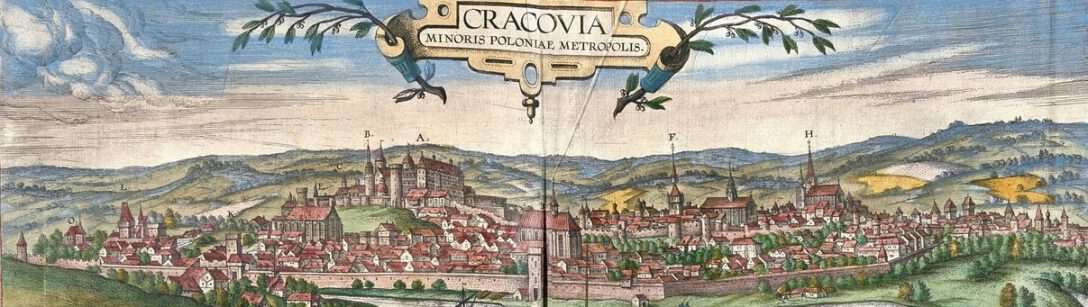
Travel bursaries Kraków 2028

Thanks to all those who generously donated money to our two Memorial Funds, the IANLS is pleased to offer a number of Travel Bursaries to help doctoral students and early career researchers (within three years of their PhD award at the time the Congress takes place) meet the costs of travel to the Twentieth International Congress of the IANLS in Kraków, Poland. Up to 12 grants of € 300 will be made available.

Please send the completed form via the Congress Registration System between 7 January and 30 April 2027 with your submission of the conference abstract.

The form may be completed in any of the IANLS’ official languages. The applicants will be informed of the outcome of the application by 15 October 2027.

Download the form as DOCX.

1st Circular Letter Triennium 2025–2028

Download the full circular letter as PDF.

The Twentieth International Congress of the International Association for Neo-Latin Studies is being organized by the IANLS and the Jagiellonian University in Kraków. The theme of the Congress will be “Respublica Latina / Rzeczpospolita Łacińska”.

The Congress will take place from 23 to 29 July 2028 in Kraków, Poland. It will start with registration on Sunday 23rd July and the official Opening Ceremony on Monday 24 July and will close with the optional excursion on Saturday 29 July.

The deadline for all proposals is 30 April 2027. Proposals should be submitted to the Local Organizing Committee in Kraków via the Registration System of the Congress website. Scholars proposing papers and/or posters or organizing and participating in special sessions must be paid-up members of the IANLS when they send their proposal, i.e. before 30 April 2027. Those interested in sending a proposal who are not IANLS members should contact the secretary concerning membership.

For general questions regarding the congress, please use the email address: IANLS-2028@uj.edu.pl.

To stay up to date, please be sure to check the official congress website at IANLS-2028.confer.uj.edu.pl.

Spring School “Neo-Latin Literature in and about Rome”

Rome, 14/05/2027 – 22/05/2027

Submission deadline: 07/01/2027

The Teaching Committee of the IANLS, in cooperation with the Royal Netherlands Institute in Rome (KNIR) and the Norwegian Institute in Rome (DNIR), is organizing a new edition of their Neo-Latin spring school. It is entitled “Neo-Latin Literature in and about Rome” and will take place from 14–22 May 2027 in Rome.

It is open for MA students and PhD candidates – the course language will be English.

The deadline for application is 7 January 2027.

See the full call for participation and further information about the program HERE.

CfP: RSA 2027 – Panel “The Many Virgils of the Renaissance”

Philadelphia, PA, 11/03/2027 – 13/03/2027

Submission deadline: 31/07/2026

Few classical poets could compete with Virgil in occupying a privileged position within Early Modern literary culture, not only within Europe but also in a broader global Renaissance context. Humanists, poets, educators, missionaries, and political thinkers across Europe and its overseas territories turned to his works as models of language, genre, authority, and cultural memory. Yet Early Modern engagements with Virgil were far from uniform. His poetry was continually adapted to address new intellectual, political, religious, and geographical realities.

This session seeks to explore the diverse ways in which Early Modern authors reimagined Virgil across a broad transnational landscape, with a particular focus on the transatlantic world. Bringing together studies of both European and colonial contexts, the panel aims to showcase how Virgilian texts, motifs, and poetic strategies circulated between the centres and peripheries of the Early Modern world (with a focus not only on European countries, but also on Central and South America), acquiring new meanings in the process. Contributions are invited to investigate how writers employed Virgil to construct political legitimacy, frame imperial and missionary enterprises, describe unfamiliar landscapes, negotiate local identities, and participate in evolving humanist traditions.

Rather than treating Virgilian imitation as a passive inheritance, the session emphasises the creative and often transformative uses of classical authority. By placing European and American materials in dialogue, it highlights the interconnected nature of Early Modern literary culture and demonstrates how Virgil served as a shared point of reference through which authors articulated both common ambitions and distinct local concerns. In this panel, we hope to find not a single Renaissance Virgil, but multiple Virgils shaped by different communities, languages, genres, and historical circumstances, thus contributing to ongoing discussions about classical reception, cultural exchange, and the global dimensions of Renaissance humanism.

The panel is organized by Leni Ribeiro Leite and Giacomo Comiati and is co-sponsored by HESPERIDES and the IANLS.

More information at rsa.org HERE.

CfP: RSA Annual Meeting 2027

Philadelphia, PA, 11/03/2027 – 13/03/2027

Submission deadline: 24/07/2026

Call for Paper and Panel Proposals
Renaissance Society of America Annual Meeting 202
7

Proposals are sought both for individual papers and for entire sessions (normally three papers), on any topic concerning Latin in the Renaissance, to be sponsored by the International Association for Neo-Latin Studies at next year’s Annual Meeting of the Renaissance Society of America, to be held in Philadelphia, USA, from Thursday, 11 March – Saturday, 13 March 2027.

As a large Associate Organization of the RSA, the IANLS will be allotted up to four panels. Sponsorship of a panel by the IANLS normally means that the panel will be accepted by the Program Committee for presentation at the RSA Annual Meeting without further vetting, provided the panels comply with the RSA guidelines. Please keep in mind that, if you send an individual proposal that is not part of a pre-formed panel, the IANLS cannot guarantee that the proposal will automatically fit into one of the four allotted panels.

Proposals should include all the information listed in the Submission Guidelines on the RSA website under ‘What’s in a proposal?’. Please pay careful attention to the restricted word count, as the RSA’s submission system will not accept entries that exceed maximum limits. Incomplete proposals will not be considered.

Everyone who presents at the Annual Meeting must be a member of RSA at the time of the meeting; for details see the Submission Guidelines on the RSA website under ‘RSA Membership and Eligibility’.

Applicants for inclusion into one of the IANLS panels will normally be expected to be paid-up members of the IANLS (or will be expected to join the Association).

Please do not submit a proposal unless you are confident that you will have the time and the funds to attend the meeting. Each year we see a certain number of people dropping out well past the deadline or even quite close to the meeting itself. Unexpected problems can obviously arise, but every withdrawn paper means an opportunity lost to, and a place taken from, another IANLS member, who wanted to participate.

Proposals should be sent to Marianne Pade, who is the IANLS representative with the RSA, at pade@cas.au.dk, no later than Friday 24 July 2026. Proposals will be refereed, and everyone will be notified in due course about whether or not the proposal has been accepted by the IANLS for inclusion into one of the four panels. Anyone whose proposal is not accepted for the IANLS panels will be informed in time in order to be able to submit as an individual; please note, though, that in that case the submission will be evaluated by the Program Committee of the RSA.

Download the CfP as PDF.

Artificial Intelligence in Neo-Latin Studies

Online, 20/02/2026

Artificial Intelligence in Neo-Latin Studies: Prospects and Concerns
A roundtable discussion

The Committee for Digital Resources of the International Association for Neo-Latin Studies is pleased to invite you to an online roundtable discussion entitled “Artificial Intelligence and Neo-Latin Studies: Prospects and Concerns”.

The session will bring together scholars interested in exploring how recent developments in artificial intelligence are reshaping the study, editing, interpretation, and teaching of Neo-Latin texts. We aim for a lively and inclusive exchange across disciplines and career stages.

Format
The roundtable will begin with a series of 5-minute introductory talks by five speakers – Marco Cristini, Lev Shadrin, Patrick Burns, Mads Rosendahl Thomsen, Sarah Lang –, each presenting a focused idea, project, or challenge at the intersection of AI and Neo-Latin Studies (the abstracts can be found here). These short interventions will be followed by an open discussion, encouraging questions, reflections, and broader conversation among all participants.

Time and place
Friday, 20 February 2026
2:00–3:30pm Central European Time
Online via Zoom: https://zib-de.zoom.us/j/66429993353

Whether you are actively using AI tools in your research or are simply curious about their implications for Neo-Latin Studies, we warmly welcome your participation. To help us with planning, we kindly ask those interested in attending to complete a short form here.

Please feel free to share this invitation with your colleagues.

We hope you can join us for what promises to be a stimulating and forward-looking discussion.

With best regards,
IANLS Committee for Digital Resources

19/02/2026 programme updated

Submission to the Acta Conventus Neolatini Aquisextiensis 2025

Dear participants of the IANLS congress,

A few days ago, we had a wonderful IANLS congress in Aix, and the local organisers did a great job for all of us. Now, it is time to think about the publication of the proceedings. If you want to publish your paper in the Acta Conventus Neo-Latini, please, have a look at the style sheet and send your article (max. 28,000 characters, including spaces and footnotes) by 30 November 2025 to florian.schaffenrath@uibk.ac.at.

Remember that only participants who presented their paper personally at the congress, are allowed to publish it in the Acta.

After a formal check of your submission, we will send it to at least two peer reviewers, and we will let you know about their comments and reviews as soon as we get them. In the end, we will only be able to publish a selection of c. 50–60 papers.

If you have any further questions, please, write to Florian Schaffenrath. I am looking forward to receiving your submission, and together with Béatrice Charlet-Mesdjian, I will do my best to publish the volume in due time.

All the best,
Florian Schaffenrath
General Editor of the Acta Conventus Neo-Latini

3rd Circular Letter Triennium 2022–2025

Preparations for the Nineteenth International Congress of the International Association for Neo-Latin Studies to be held in Aix-en-Provence between 14 and 19 July 2025 have advanced into their final stage.

For information and announcements concerning the congress, please see the official homepage: https://ianls-2025.sciencesconf.org/.

The program is available online at the same address, as well as the abstracts of the individual papers, special sessions, and posters.

Download the full circular letter as PDF HERE.

CfP: RSA Annual Meeting 2026

San Francisco, 19/02/2026 – 21/02/2026

Submission deadline: 25/07/2025

Call for Paper and Panel Proposals
Renaissance Society of America Annual Meeting 2026

Proposals are sought both for individual papers and for entire sessions (normally three papers), on any topic concerning Latin in the Renaissance, to be sponsored by the International Association for Neo-Latin Studies at next year’s Annual Meeting of the Renaissance Society of America, to be held in San Francisco, 19 to 21 February 2026.

As a large Associate Organization of the RSA, the IANLS will be allotted up to four panels. Sponsorship of a panel by the IANLS normally means that the panel will be accepted by the Program Committee for presentation at the RSA Annual Meeting without further vetting, provided the panels comply with the RSA guidelines. Please keep in mind that, if you send an individual proposal that is not part of a pre-formed panel, the IANLS cannot guarantee that the proposal will automatically fit into one of the four allotted panels. Proposals should include all the information listed in the Submission Guidelines on the RSA website under ‘What’s in a proposal?’. Please pay careful attention to the restricted word count, as the RSA’s submission system will not accept entries that exceed maximum limits. Incomplete proposals will not be considered.

Everyone who presents at the Annual Meeting must be a member of RSA at the time of the meeting; for details see the Submission Guidelines on the RSA website under ‘RSA Membership and Eligibility’. Applicants for inclusion into one of the IANLS panels will normally be expected to be paid-up members of the IANLS (or will be expected to join the Association).

Please do not submit a proposal unless you are confident that you will have the time and the funds to attend the meeting. Each year we see a certain number of people dropping out well past the deadline or even quite close to the meeting itself. Unexpected problems can obviously arise, but every withdrawn paper means an opportunity lost to, and a place taken from, another IANLS member, who wanted to participate.

Proposals should be sent to Marc Laureys, who is the IANLS representative with the RSA, at m.laureys@uni-bonn.de, no later than Friday 25 July 2025. Proposals will be refereed, and everyone will be notified in due course about whether or not the proposal has been accepted by the IANLS for inclusion into one of the four panels. Anyone whose proposal is not accepted for the IANLS panels will be informed in time in order to be able to submit as an individual; please note, though, that in that case the submission will be evaluated by the Program Committee of the RSA.

Download the CfP as PDF.

CfP: Staging the Heroine

Leiden, 03/06/2026 – 05/06/2026

Submission deadline: 01/09/2025

Staging the Heroine: The Construction and Performance of Female Heroism in Literature, the Visual Arts and Theatre (c. 1350–1800)

In early modern culture, heroines are almost omnipresent: they play an important role in narrative fiction and poetry, are described in biographies and collections of epigrams, are depicted in paintings and engravings, rendered in sculptures and staged in tragedies, melodramas, pastorals and in the early modern opera. Our conference/project aims at mapping the presence, representation, adaptation and evaluation of female heroines in literature as well as in the visual and performative arts.

The fundamental aim of the project is to understand how literary, rhetorical, pictorial and performance-related devices were used to stage heroines across different media. Rhetoric is here understood in a broader sense, e.g., including the literary techniques of heroic characterization, and the narratological strategies used to turn actions by women into acts of female heroism. We also include here the conceptualisations of heroic (normally tragic) female characters, as they were prescribed in early modern artes poeticae, often in explicit or implicit dialogue with Aristotle’s influential Poetics. We are further interested in pictorial devices, such as the ability of visual artists to express emotions through the body language and facial expressions of the protagonists, and through the creation of a mis-en-scene. We especially encourage participants to investigate possible cross-fertilisation between artistic fields: how did textual rhetoric influence the visual and performative arts – and vice versa, what role did pictorial rhetoric play in the composition of literary texts, theatre plays or opera? Was there a theatrical manner of staging heroines in painting? We are also interested in the influence of performance practices on the conceptualisation of female heroism: how did the then current embodied techniques that actors and singers used to express emotions influence the construction of the heroine? Were there specific performance guidelines for male actors portraying female characters?

Closely related to this set of questions is another major area of interest to the project, which regards the role that exemplary heroines from classical antiquity and the biblical tradition played in the formation of early modern heroines. What textual and pictorial sources were used by early modern artists and writers, how did they interpret, appropriate, adapt, reshape and applythem? How do female heroic figures acquire a new configuration or greater heuristic complexity in the translation of sources into another medium, language, and/or historical and cultural context? How do artworks redefine female heroism in this process of transmission and reception? The project especially encourages cross-medial and/or diachronic analyses of the representation of prominent heroines (e.g., Judith, Dido, Medea). What points of continuity and discontinuity can be discerned in different interpretations and representational strategies of the female heroism of such well-known figures in literature, the visual arts and on the stage? How do differences relate to specific historical circumstances and institutions, and to ongoing philosophical debates about female virtuosity, religious beliefs, intellectual practices and political developments?

From this perspective, we particularly welcome source-oriented contributions tracing the reception or afterlife of specific textual models. What exactly was the impact of formative models such as the tragedies of Seneca or Ovid’s Epistulae heroidum on the early modern construction of heroines? And what was the role of early modern textual models such as Boccaccio’s 14th-century mythographical works De mulieribus claris and Genealogia deorum gentilium? De mulieribus claris was one of the most successful works of the period, appearing in numerous translations and editions. It would be interesting to map its reception between c. 1360 and c. 1700 and to tease out the role it played in the formation of the early modern heroine. The same is true for other modern models: how did, e.g., the great female figures of vernacular epics like Ariosto’s Orlando furioso or Tasso’s Gerusalemme liberata impact representations of and discourse on female heroism?

Since the project aims at yielding new insights into early modern approaches to female virtue and heroism, literary, rhetorical and pictural analyses should be based on fundamental, culturally grounded questions such as: is there a specific set of female virtues and vices that recur in heroines, and if there is, how does it relate to traditional catalogues of male virtues and male exemplarity? Is mental complexity ascribed to those female characters who were generally portrayed as negative, destructive or sinful (like Medea or Cleopatra), or rather to those who were positively evaluated for displaying a kind of moral behaviour that was in line with current Christian values? Was it specifically the violation of current moral values that fuelled the early modern fascination with heroines? Was the attention paid to female heroism (and anti-heroism) part of the emerging interest in cultural criticism, e.g. by humanists and other early modern intellectuals? Was it also part of the moral education of males who were taught not to fall victim of so-called destructive women?

We invite proposals that engage with the approaches and questions outlined above. Abstracts (of max. 250 words) should be sent to Christoph Pieper (c.pieper@hum.leidenuniv.nl) by 1 September 2025.

We plan to publish the results of the conference as an edited volume in the series Intersections (Brill/De Gruyter) in 2027.

Karl Enenkel (Münster)
Emma Grootveld (Leiden)
Christoph Pieper (Leiden)
Jed Wentz (Leiden)

Download the CfP as PDF.